

In traditional ports, we often see scenes like this: truck drivers queuing and waiting at the gate, cargo owners unable to track the real-time location of their goods, and terminal loading and unloading plans frequently delayed due to poor information flow. These fragmented inefficiencies represent the "hidden costs" of the entire logistics chain.
Smart ports are the answer to this dilemma. By building a cyber-physical system, they comprehensively connect supply and demand sides to an integrated collection and distribution system, achieving a transformation from "people searching for goods" to "data-driven cargo flow." Their signature intelligent supervision, intelligent services, and automated loading and unloading not only greatly improve operational efficiency and resource utilization but ultimately lay a solid foundation of high safety, high efficiency, and high quality for the modern logistics industry.
Project Overview
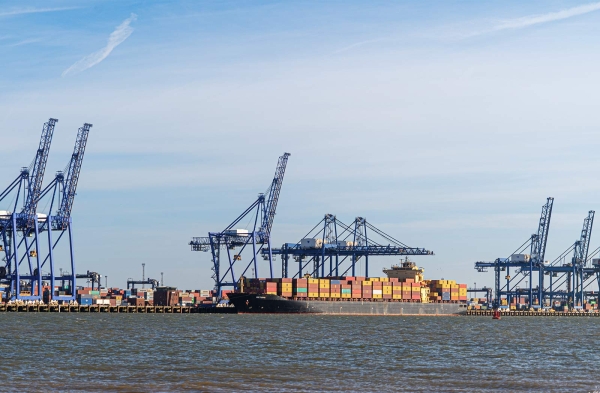
This port has 56 productive berths, including more than 40 berths of over 10,000 tons, with a huge annual throughput and an average monthly roll-on/roll-off and lifting operation volume exceeding 10,000 times, making its operations highly busy. Against this backdrop, it has extremely demanding requirements for the capacity, coverage, real-time performance, and stability of wireless communication.
Maxon has custom-designed an industrial-grade wireless network system for this purpose, achieving seamless coverage across the entire port area. The project deployed a large number of industrial-grade wireless devices to comprehensively guarantee real-time data interaction, precise positioning, and remote control of key automated equipment such as AGVs, rail cranes, and reach stackers. It also integrated various applications such as container management, yard management, and emergency communication, ultimately achieving an overall leap in port operational efficiency and safety management levels.
Project Challenges
The port environment is open, and the stacking of containers creates numerous signal blind spots and reflection areas, making it difficult for traditional networks to achieve stable and seamless coverage; large machinery and frequency converters generate strong electromagnetic interference, requiring wireless equipment to have excellent anti-interference capabilities to ensure that critical commands are not interrupted or lost; at the same time, the equipment is exposed to high temperature, high humidity, and high salt spray environments year-round, requiring IP68 high protection, lightning protection, and wide temperature performance to withstand the challenges; and critical businesses such as automated control and real-time positioning are extremely sensitive to latency and packet loss, and any communication fluctuations could trigger safety accidents or efficiency losses. Solution
Maxon has deployed a comprehensive wireless communication solution for the port, centered around industrial wireless access points (APs) and bridges.
Building a fully covered wireless backbone network: Maxon's industrial-grade wireless APs are deployed at various strategic locations in the port, forming an 802.11r seamless roaming Wi-Fi network. This ensures "zero packet loss and zero perceived interruption" base station switching for mobile devices such as AGVs and cranes in complex areas, guaranteeing continuous data transmission.
Enabling precise control of automated equipment: AGVs connect to wireless APs via WiFi, and rail-mounted vehicle terminals are installed on rail cranes, providing a reliable wireless communication link. This enables real-time uploading of precise location and operating status, and reliable reception of scheduling commands from the central control system, forming a "sensing-decision-execution" closed loop to improve the efficiency of automated operations.
Achieving remote monitoring and safety warnings in hazardous areas: Dedicated explosion-proof wireless base stations are deployed in explosion-proof (Exd IIC T6) and harsh (IP68) environments such as oil tank areas and chemical warehouses, enabling real-time collection of environmental parameters (temperature, pressure, gas concentration) and remote video surveillance, providing a guarantee for safe production.
Streamlining data flow and optimizing container management: The wireless network transmits container identification, status, and location information in real time, and integrates with the back-end management system (TOS) to achieve dynamic tracking of containers and precise management of yard inventory, significantly reducing ship turnaround time in port.
Project Advantages
Maxon's industrial-grade wireless base stations ensure 7×24 continuous operation with anti-interference, high protection, and stable operation industrial-grade equipment; achieve seamless coverage of the port area, guaranteeing zero data interruption for mobile devices, directly improving the efficiency of core operations such as AGVs and cranes; build a comprehensive "information neural network," connecting equipment, operations, and management data to support intelligent decision-making; and avoid large-scale wiring through a wireless architecture, significantly reducing total cost of ownership through flexible deployment and convenient maintenance.
Case Study
As a core hub of the global supply chain and a key node of land and water transportation, ports face complex and ever-changing operating environments and harsh climate conditions, posing significant challenges to traditional wired deployments. Against this backdrop, promoting informatization and building automated, intelligent, and digitized modern ports has become a strategic priority for the industry's development.
With its excellent anti-interference capabilities, industrial-grade high-protection design, and continuous and stable operation, Maxon's wireless transmission products have built a solid communication foundation for intelligent port management. By deploying Maxon wireless base stations, reliable interconnection and intelligent linkage of equipment in all scenarios, including lifting areas, loading and unloading areas, high-altitude operation areas, and enclosed operation areas, have been successfully achieved, comprehensively safeguarding port operation safety and operational efficiency.
https://mxcomm.cn/news/3959.html#sigProId02317fdfbc