

Forests, as the Earth's largest terrestrial ecosystem, serve as a gene bank, carbon sink, water reservoir, and energy source, playing a crucial role in maintaining global ecological balance and representing a core resource and environment for human survival and development. Forest protection focuses on fire prevention, preventing illegal logging and poaching, and protecting ecological balance. Wireless monitoring systems enable real-time monitoring and timely intervention against illegal activities, while also providing support and safety assurance for relevant personnel, making them a key solution for forest protection and utilization.
Project Overview
Application Scenario: Addressing core needs such as forest fire prevention, preventing illegal logging and poaching, and ecological protection in the special environment of vast and complex forest areas.
Core Objective: To transmit front-end video images to the monitoring center in real time using wireless communication technology, while simultaneously providing feedback on monitoring commands to achieve remote protection and management.
System Features: No reliance on wired fiber optic cables, short construction period, wide coverage, low cost, easy maintenance, flexible scalability, and the ability to adjust installation locations and add monitoring points as needed.
Project Challenges
Environmental and Topographical Constraints: Forests are vast and have complex terrain, making wired fiber optic cable laying difficult, and requiring protection of vegetation, preventing arbitrary trenching and pipe laying.
Power Supply and Stability Requirements: Monitoring points in mountainous areas are far apart, making power supply difficult. The system needs to operate stably under harsh weather conditions such as wind, lightning, rain, and fog.
Transmission Adaptation Requirements: The distance between different monitoring points and the monitoring center varies greatly (within 5 kilometers, 10 kilometers, 20 kilometers), requiring the system to meet different bandwidth requirements and provide redundancy.
Solution
Networking Method
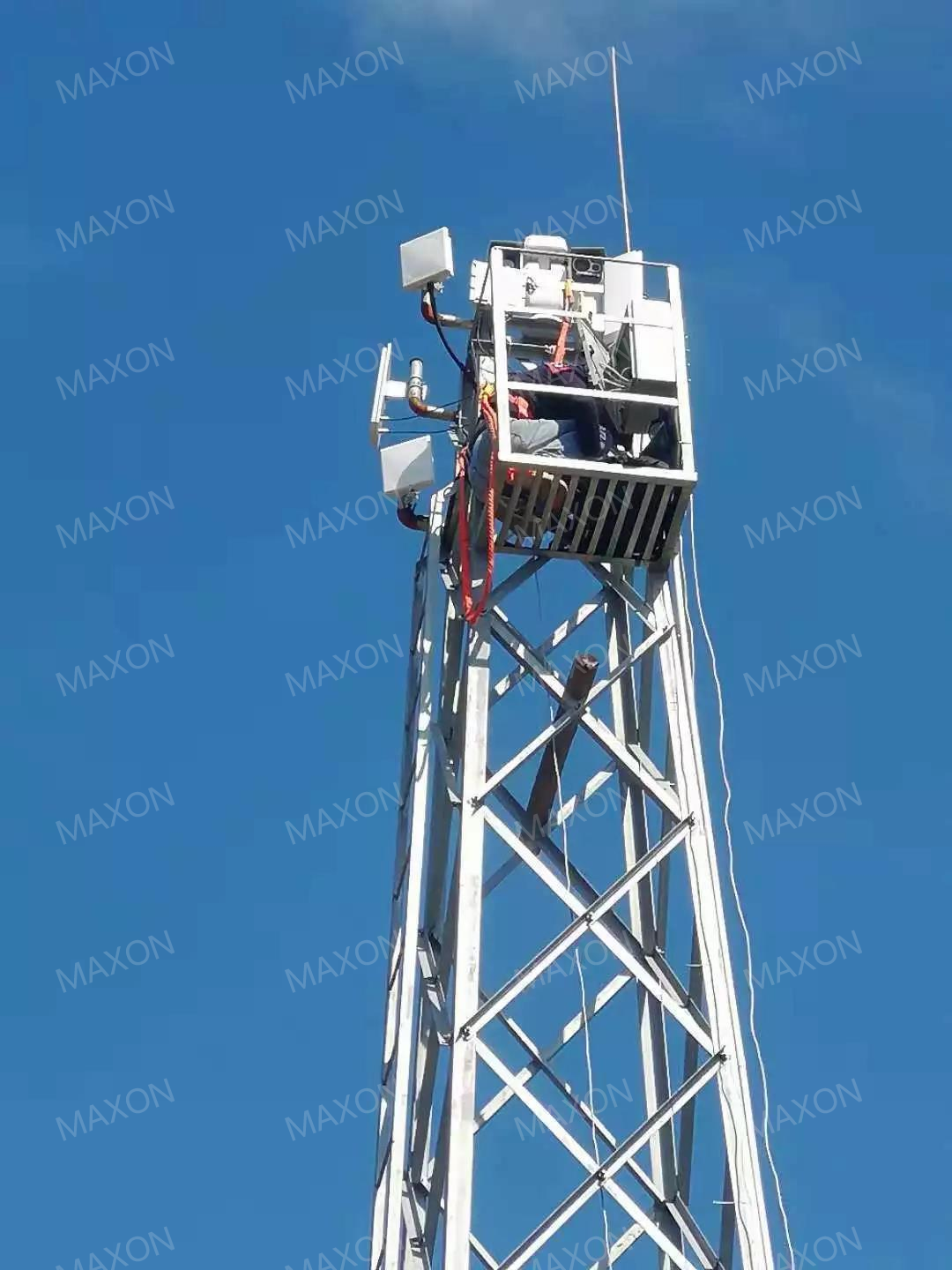
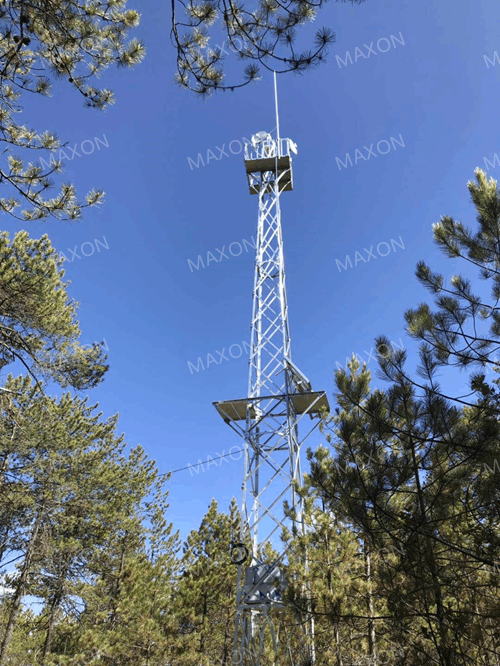
The entire forest area is equipped with 9 monitoring points, each with a 4-megapixel thermal imaging network camera. The distance between each monitoring point and the central point is approximately 0.7 to 3.6 kilometers;
There are no obstructions between the monitoring points and the starting point, and the transmission conditions are good; Based on the point distribution, the transmission is divided into three link groups: 1VS2, 1Vs2, and 1Vs6. The Maxon MX5011B-DI16 supports dual gigabit network ports, so if the number of cameras at the front-end monitoring point does not exceed two, a switch is not needed. The cameras can be directly connected to the wired ports of the network interface. Equipment Selection
Dedicated equipment is selected based on the transmission distance. The core products include:
MX5011B-DE29 Outdoor Long-Distance Wireless Bridge: Recommended for distances up to 20km, IP68 protection rating, supports 5.8GHz frequency band and 802.11 an/ac protocol.
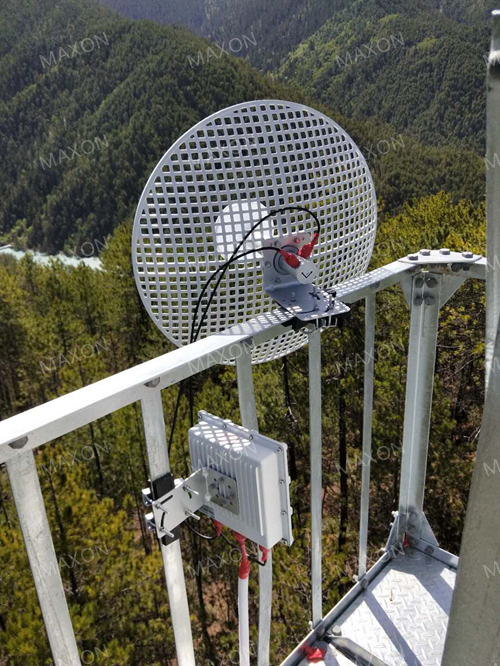
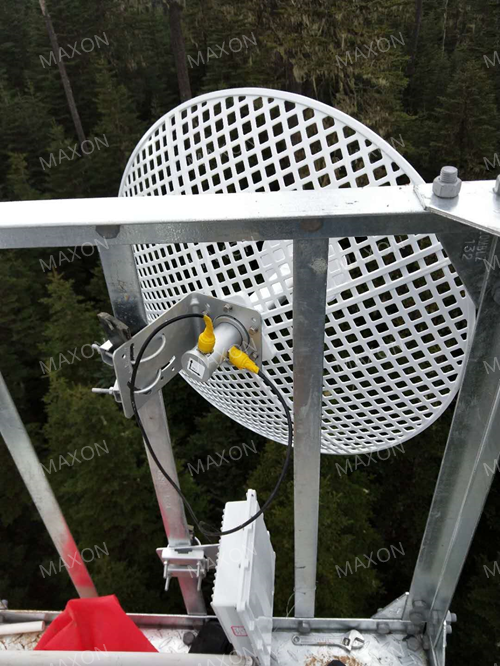
MX5011B-DI25M Outdoor Long-Distance Wireless Bridge: Recommended for distances up to 10km, integrated 23dBi butterfly antenna, maximum speed of 900Mbps.
MX5011B-DE17 Outdoor Long-Distance PTMP Wireless Base Station: Recommended for distances up to 5km, 90° sector directional antenna, supports IoT expansion.
MX5011B-DI16 Outdoor Long-Distance PTMP Wireless CPE: Recommended for distances up to 5km, built-in directional antenna, supports IP/MAC filtering and intelligent bandwidth limiting.
Core Technology Configuration
Wireless Technology: Supports intelligent channel analysis, automatic optimal channel selection, dynamic frequency selection, and automatic transmit power control.
Security Protection: Uses WPA2-PSK encryption, hidden SSID, IP/MAC filtering, and other security configurations; meets surge immunity and electrostatic discharge immunity standards.
Management and Expansion: Supports web configuration, AC remote management, and SNMP management; reserves UART interface for expanding Bluetooth, ZigBee, and other IoT applications.
Project Advantages
This project is specifically designed for complex forest environments, demonstrating excellent overall adaptability. Its core equipment features IP68 protection and a wide operating temperature range of -40°C to 70°C, unaffected by terrain, vegetation, harsh weather, and electromagnetic interference, ensuring long-term stable operation. Furthermore, the solution utilizes a wireless architecture, offering convenient installation and low maintenance costs, significantly reducing total lifecycle costs compared to traditional wired solutions. At the same time, the Maxon industrial wireless system integrates real-time monitoring, command interaction, and security protection, and includes reserved interfaces for IoT expansion, providing a comprehensive solution that fully meets the multi-dimensional needs of forest protection in terms of coverage, stability, cost, and functionality.
https://mxcomm.cn/news/3954.html#sigProId0b38a17cfa